Signs Your Sewer Line Is Failing — and What to Do Next
Every drain in your home meets in one underground line. When that line starts to fail, the signs show up inside first — slow drains everywhere, gurgling, sewer smells and backups that keep coming back.
The fast answer: one drain or every drain?
A single slow sink is usually a local clog in that fixture or its branch line. A failing sewer line behaves differently, because every toilet, tub, shower and sink in the house drains into the same underground main on its way to the street. When that main is cracked, blocked by roots, sagging or collapsing, the symptoms appear in more than one room at once: several drains slowing together, the lowest toilet or basement floor drain backing up first, and problems that return days after a clearing that seemed to work. That pattern — whole-house, repeating, and worst at the lowest fixtures — is the fastest way to tell a sewer line problem from an ordinary clog before anyone starts digging.
Sign one: backups and slow drains all over the house
Watch where the backup happens. Wastewater takes the lowest open exit, so a failing main often announces itself at a basement floor drain, a ground-floor toilet or a tub, even when the blockage sits far out in the yard. Flushing an upstairs toilet makes a downstairs fixture gurgle or rise. Two or more fixtures misbehave at the same time. And the clearing does not hold: a line opened by a cable that blocks again within weeks is rarely a new clog each time. It is usually the same damaged section catching the same waste, which is exactly the pattern sewer line repair is meant to end rather than repeat.
Sign two: gurgling, sewer smells and a suspiciously green yard
Air has to move through your drainage system as water flows, and a restricted main traps and pushes that air back through traps and fixtures — that is the gurgling you hear from a toilet after a shower runs, or from a sink when the washing machine drains. Sewer odour inside, especially near floor drains or in a basement that used to smell fine, points the same way. Outside, look along the path the line takes to the street: a strip of grass that is greener, taller or soggier than the rest of the yard, in dry weather as well as wet, can mean wastewater is leaking from a cracked joint and feeding and watering that soil. One sign alone can have a simpler cause. Two or three together deserve a proper diagnosis.
What actually fails underground: roots, age, bellies and offsets
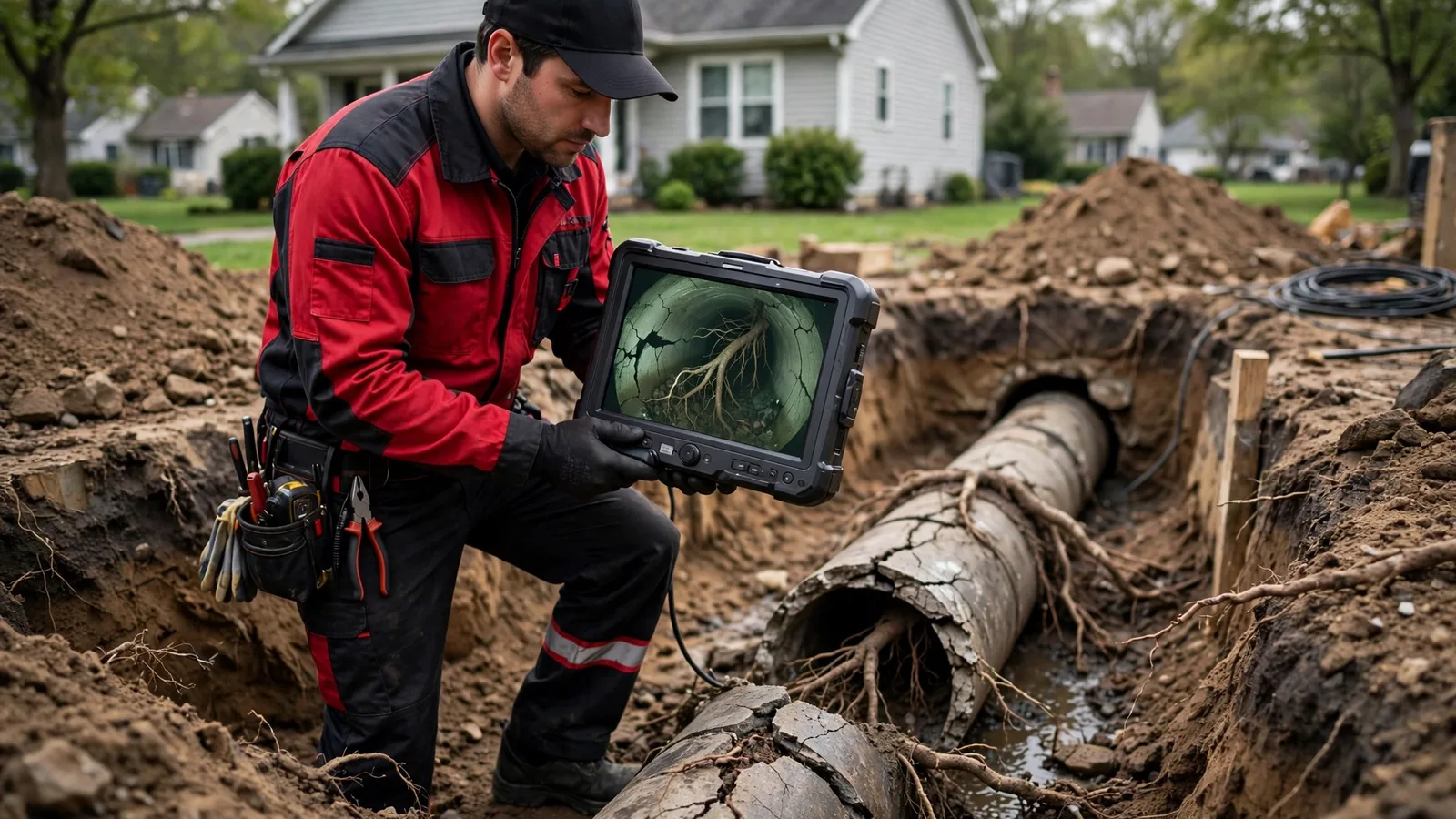
Most failing lines fail for one of a short list of reasons. Tree roots seek the moisture and nutrients inside a sewer line and enter through tiny joint gaps, then grow into a mass that catches everything passing it. Older clay and cast iron lines, still in the ground under many homes in Beltsville, Laurel and Hyattsville, crack, corrode and separate at the joints as decades pass. A belly — a sagging section where the soil beneath has settled — holds standing water and waste instead of letting it flow, so it silts up again and again. An offset joint, where two sections no longer line up, creates a lip that snags paper and debris. None of these is fixed for long by clearing alone, because the shape of the pipe itself is the problem.
What not to do — and when it becomes urgent
Skip the chemical drain cleaners. They do not remove roots, repair a crack or lift a belly, and the caustic liquid sitting in a blocked line makes later professional work more hazardous. Do not keep flushing and running water to test whether a backup has cleared itself — every gallon you add has to go somewhere, and with a blocked main it comes back at the lowest fixture. Treat active sewage backing up into living space as urgent: stop using water, keep people and pets away from the affected area, and call for help rather than mopping sewage toward another drain. A slow drain with no backup is not an emergency tonight, but it is a diagnosis to book this week, before it becomes one.
Diagnosis first: a camera shows the line before anyone digs
The right first step is looking, not excavating. A video camera pipe inspection travels the full length of the line, shows whether you are dealing with roots, a crack, a belly, an offset or simple buildup, and pinpoints the problem spot and its depth from the surface. That picture decides the repair. Buildup and roots in a sound pipe can be cleaned thoroughly. A single broken section can often be spot-repaired by digging only at the marked spot. A longer damaged run may suit trenchless sewer repair, which renews the line from inside with little or no digging, while a collapsed line may leave full replacement as the only honest option. Anyone quoting a major repair without that inspection is guessing with your yard and your money.
When to call us
Homes in Beltsville and Laurel sit on the same generations of underground piping, and we see the same progression in both: a backup cleared here, a gurgle ignored there, then a basement floor drain that finally overflows. If two or more signs in this guide sound familiar — or you have paid to clear the same main more than once — call Eagle Plumbing at (240) 266-8317 or send the lead form on this site. We will camera the line first, show you exactly what is failing and where, and price the spot repair, trenchless option or replacement that the evidence supports, before any digging begins.
Need Help With This?
Our related service: Sewer Line Repair — Sewer line diagnosis and repair — we find the problem with camera inspection and repair it properly, including trenchless options.